12.The right STuFF.. moRe or leSs
This chapter is about our gear and food and any stuff we had or wished we had more or less of. The temperatures varied from 5 above to -40 below F (and lowe, our thermometer didn't go lower than that).
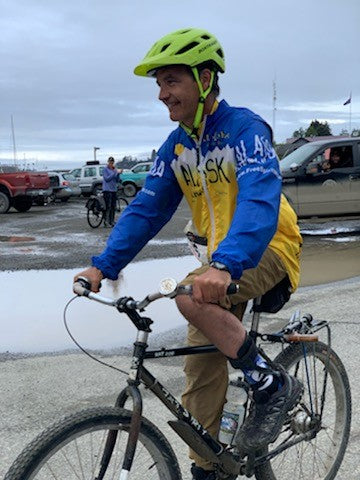
I rode the Surly Pugsley with Surly Endomorph (gum walled) tires on Surly Large Marge wheels. Single speed, 22x16/18/20. We mostly used 18 and we used 16 once on the frozen flat Buckland River. Pat had his lovely Pink Surly bike 1X1 that he converted (hacked and welded) to fit the Surly Large Marge wheels. He used the Surly black walled Endomorph tires.(I am getting black walled tires for next time) I can't believe I said NEXt time..
We both used custom Nitto Albatross Cruiser handle bars that Pat heated and shaped for comfort(no worries about wind resistance at 5-10 MPH). On the handle bars we each had a set of snow machine Pogies - big giant warm pockets for our hands.
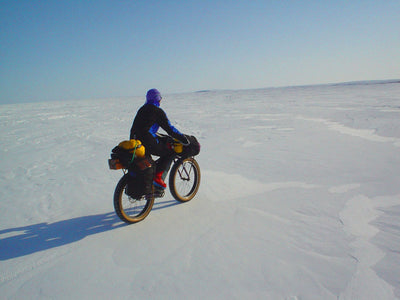
We purchased awesome Frame bags that fit in the triangle part of the frame from Wildfire Designs. These frame packs were a great use of that normally wasted space. We loaded all our heavy meals in them.
We had a rack on the front and on the back. We each had ONE pannier on the back frame. We each had a sleeping bag. Mine was -40 below but did not keep me warm (since this trip , we returned it to North Face and they sent us a new one that is absolutely HUGE but looks like it should work) Pat used a REI -20 below synthetic bag and he was not warm either. The zipper was also hard to work from the inside of bag and he ended up ripping the bag trying to open it. So we returned that bag too.
We each had a Z-Rest sleeping pad. They are big and bulky but they are light! Next time though- we will bring 2 each. Sleeping on the ice will teach you that!
We boiled water, put it in our water bottles and slept with the bottles. Caution: We heard that HARD plastic nalgene bottles crack sometimes when you do this! A man did this during a race up here and he soaked his sleeping bag! So we used the SOFT (not hard-and sort of a white transparent ) that mountaineers use. We found some at a hunting/sportsman type store.
We each had wide platform pedals for our big giant warm boots. In our experience, we have not found any clipless pedal set ups that keep our feet warm in -40 temps. Well unless you have the circulation of a polar bear. We just felt safer with our set up, since these would be our ONLY shoes and also we were not sure how much walking/pushing we would be doing.
I wore knee high wool Norway red boots 3 sizes too big. (I bought them on sale at Pia's Scandinavian Woolens) Many of the Iditarod mushers wear these boots too! I put 3 insoles in them. I wore a thin (Surly) wool sock , then a thick either wool or Gator fleece pair, then Gator neoprene socks over that. Gator makes the neoprene socks that breath sort of - not sure how- but they are very nice..your feet don't get too sweaty.
Over the Norway boots I had Neos Over boots, waterproof and windproof. My feet were as big as snow shoes, but they were warm MOST of the time. Since I have frozen my feet in the past I had to be very careful. And I did not freeze them on this trip.
Next trip I will bring FOOT warmers-the kind that stick to the top of your socks shaped like a dome - not hand warmers for my feet. Foot warmers are MADE to work with less oxygen than hand warmers. We tried to save money by just getting hand warmers at Costco but it was very very scary when the hand warmers would NOT get warm in my boots and I had no feeling in my cold feet one morning. Now I buy FOOT warmers and HEy they really work quick ! Could save a foot.
Pat wore a pair of high top light weight winter boots (not leather- they were a nylon breathable material) 3 sizes bigger (13), that he has worn for 100s of miles since he came to Alaska to win the Knik to Mcgrath winter bike race. For socks he wore thin wool and then thick fleece. he also had a pair of Neos over boots to protect from wind and water.
For shoes; circulation is more important than insulation so BIGGER is better for cold temperatures!
I do believe I was more stylist than Pat in my RED high top boots.
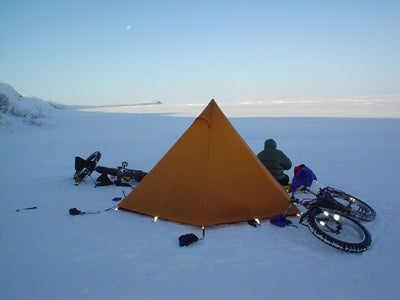
Our tent was a Go-Lite Hex pyramid tent with one pole and a separate floor attached to it. It's a great tent, but not for this kind of camping. It must be well staked out to pitch and stay up in the wind, so we took tent stakes for hard pack and 11 small nylon bags to fill with snow and bury for anchoring in loose snow. Our first night on the frozen ocean had a hard snow crust with soft sugar snow underneath. We managed with a combination of both stakes and snow anchors but it took forever and it would have been hell if a storm had come up. We went with this tent for it's lightness and 1-pole design, but next time we'll take a free standing one. We have a Bibler that's ideal, but a bit small for 2 of us and gear, so we're planning on getting another, bigger model.
We both were very happy to find Lands End down jackets on sale at Sears for $49! I Had to get a large so it was long enough.But I have nothing but good to say about that jacket. I did have to sew the hood on ( for some reason it was a snap-on hood ). But other than that it kept me warm when I was very tired and cold. I was able to sit on the frozen Arctic ocean at -30 below in the wind and cook dinner and I was warm! Lands Ends latest version down jacket looks even better now. Gee this sounds like an ad. I should email them this and get a deal.
ah-ha
We each had 2 OR insulated water bottle carriers that each held a 1 quart Nalgene bottle that hung from the handlebar. We filled them with boiling water in the morning and they lasted all day, but in the late afternoon they'd start to freeze when we drank the last of it. That's when we knew to start looking for a campsite, fire up the stove for tea and hot food, and settle in for the night. This is so much more fun than racing through Alaska and not taking the time to enjoy a good cup of tea! And boy, I don't miss sleep deprivation one bit! Yup this was FUN.
For riding clothing it was tricky to stay warm in cold temps and be working out, sweating, and not get cold especially in the constant wind. I was very happy with my Smartwool long underwear bottoms and Ibex wool shirts. They were soft and warm and wicked fast. As a base layer I was also very happy with a Sugoi hooded mid weight top. Not only did I have the extra layer on my head (under my hats) that I wore all the time( even at night), but the material wicked so fast I NEVER felt damp. (found that at Paramount Cycles)
Staying dry was very important because as soon as we stopped for anything it was creepy how cold it was with the wind. If there was any dampness on me I began to shiver right away. So evey time we stopped I learned to put my down coat on that I kept strapped on back of bike in easy to reach spot.
For "underwear" we did not wear any. Yup, too much information I know, but Pat said hey tell the world, might save a life!
I also could not find an athletic bra that wicked well enough either so that was out too. Pat and I wore the baggy type of wind resistant (synthetic chamie) cycling shorts that wicked pretty well. I had heard great things about Ibex Wool cycling shorts, but could could not find any. Over the cycling shorts and wool mid weight long underwear I wore a pair of Swix (skiing ) side zip pants that are wind proof on front and breathable on the back. (found at Alaska Mountaineering and Hiking store)
When we stopped I also had a pair of Mountain Hard Wear synthetic insulated side zip pants. Easy to zip even in the cold and they were warm.
For my riding jacket I had a Sugoi jacket that was made out of some magic fabric that looked like Neoprene, but somehow was wind proof and breathed and was warm. It would have been nice if it had a hood because of the winds. (In Buckland I bought a jacket, took the hood off and sewed it on the Sugoi- so now I have a stylist blue Sugoi with a purple hood hand sewed on.) But overall I really liked this jacket. I got the men's large to fit over everything and so it was also long enough. When shopping for gear It was very hard to find jackets and outer wear that actually covered our bottoms. Even Patagonia's $300+ down jackets were too short for REAL cold weather.
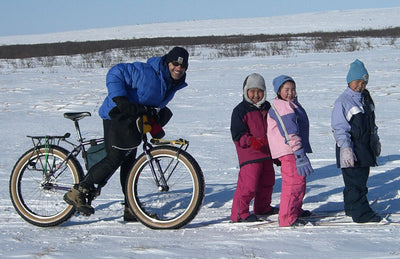
For face I wore a fleece neck warmer, a Gator neoprene face protector and goggles. A hood on my cycling jacket would have been nice-because the wind would still get to the back of neck with ALL that stuff on. My favorite hat was from Arm Navy for $5 . Plain fleece and it wicked dry in 2 seconds. It folded over so it was very warm around the ears or unfolded and stood on top of my head and made Pat (and the kids in the class rooms in Buckland) laugh.
I brought a small (chap stick size) sun block that I kept on a small rope around my neck that I used on my nose and any face parts that were exposed, all the time. I kept my digital camera on a rope around my neck and in a ziplock bag and in my front jacket pocket so it would always be warm( I slept with it too so it would not freeze). It always worked even at -40!
We wore goggles most of the time. A feat that takes practice at below 0 temps. It is very easy to frost them up and then they stay frosted. I was real happy I practiced this before we left on the trip. In the morning I would wipe them with a no frost cloth that helped. I had sunglasses too but it was too cold most of the time to wear them My eyes needed the protection of the goggles. I also wear contacts. FUn!
I pre made all our dry meals and put them in zip lock bags that we added hot water to. I also made heavy duty high calorie chocolate oat coconut bars and some heavy high protein bread ( recipe from Clair LaClair) that would put hair on your chest. We also had cheese and reindeer sausage, and dried fruit. We tried to have the highest calories possible per ounce of food. My favorite kind of diet !
All of our food was frozen solid and we had to warm it in our clothing first (like an arm pit) before eating! yum
For fuel we would bring MORE next time. The wind, dry snow and cold temps used up our fuel about 1/3 faster than we figured-after practicing around a relatively mild Anchorage/ Knik area. We would have been in trouble if we had gotten delayed by a storm.
!! IMPORTANT note about our good ol' HOMELAND Security.
They will confiscate your MSR or whatever stove no matter how new it is or that there is no gas within 1000 miles of it and that all the tiny stove parts are taken apart, washed out in soap and in different parts of your checked on luggage.
We were told by a very serious TSA dude that YES this one stove part he found with no gas could blow up a whole plane. We were very doubtful not to mention frustrated. We almost lost our brand new $180 MSR stove - as this very happy TSA guy eyed it and said wow this is a REA-A-L-L-LY nice expensive stove - wish I had one - too bad you have to give it up.
This was when we were Leaving Kotzebue. Somehow they did not notice our new stove parts when when we left Anchorage. Which would have been life threatening if they had taken it and we did not know until we set up camp 20 miles out at 40 below zero. This has happened to friends of mine. So if you do take the chance and bring a camp stove in luggage - please check BEFORE you get out in the wilderness to be sure you have it. But after this Horrible experience we do not recommend taking this chance.
This TSA person also said "OH yeah, you should see how mad the hunters get when we take their expensive stuff" ..This TSA person who had probably gotten beat up a lot in junior high was really having a good time at our expense.
Then a very nice local man we do believe was sent from Arctic Heaven, came over to me while I was over in the corner, quietly crying and swearing at Bush and his whole crazy regime and this nice person said he could ship it home for us. But not to tell anyone! It cost us $10.
So IF you are going somewhere remote you can unofficially ship these illegal life sustaining parts by freight. NOTE: You still do risk THEM finding it and taking it away but not as much as when flying and putting it in your luggage. And WASH all FUEL out with soap but also make sure all the water has been thoroughly dried out of tubes so you don't have the frozen one drop left of water frozen problem in a tube that made our stove not work and really scared us. Finally Pat figured it out and how to fix it. But I never would have known how to fix it - plus I was too cold to even look at it.
And of course NEVER ship fuel !! You buy it in the village once you get there - we at least knew this much. duh.
OK that is all I can think of for now.Will add more when we think of it later.
The End!
sort of
Side note:
Pat was diagnosed with MS in early 2004. He has chosen the holistic approach of healing for now and keeps riding his bike almost everyday all year long in Alaska. We take each day as it comes and are thankful. Lets see what crazy trip idea he comes
up with next. And see if I can keep up..
|